stage and rehearsal prep
The 90-second Drop C changeover card for fresh strings
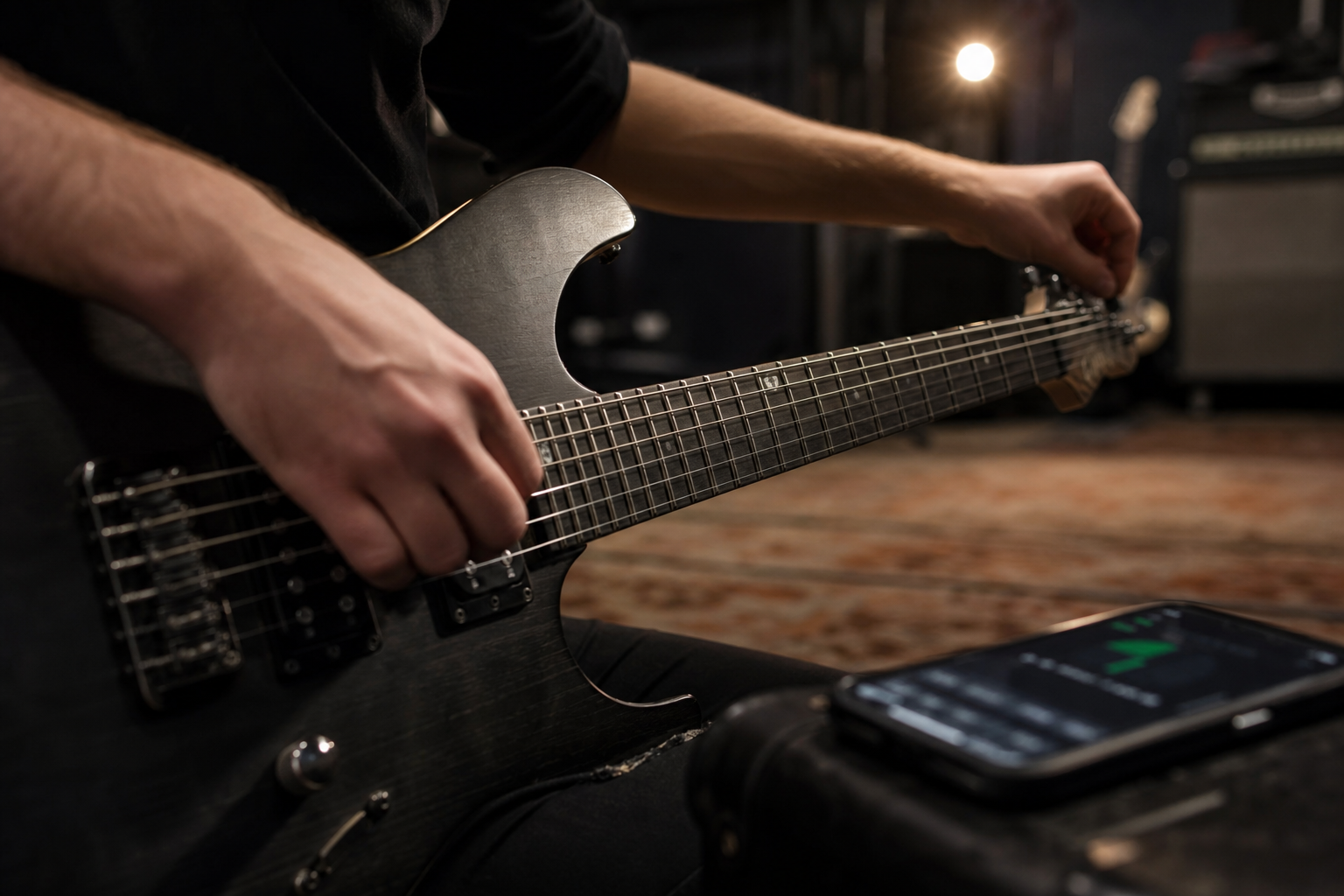
A side-stage Drop C guitar changeover card for players switching instruments: call the group reference, make fresh strings prove themselves, test the low C under real attack, and know when to stop tuning and grab the backup.
Short answer
For a Drop C guitar changeover, call the group reference first, check C2 G2 C3 F3 A3 D4 once, play the opening attack, then recheck the low C before the song. Fresh strings can drift flat after the first pass, so use muted samples and the same phone position before moving the peg again. TuneLT can help as a local microphone pitch check, but the changeover decision is whether the guitar returns to the group reference quickly enough for the set.
Turn the changeover into a timed card
A freshly strung Drop C guitar can eat the entire quiet warm-up if the player treats every flicker as a new emergency. The better frame is a changeover card: a short sequence that decides whether this instrument is ready for the next song. Players switching instruments need speed, repeatability, and a clear stop point more than they need a long tuning lecture.
Drop C on a six-string guitar is commonly checked from the sixth string to the first as C2, G2, C3, F3, A3, and D4. Write that once on the card, then spend the rest of the routine proving that the guitar returns to those targets after it is played. Fresh strings often look fine at rest and then fall when the first heavy right-hand attack stretches the low side of the instrument.
The card should answer four questions in order: what reference is the group using, did the open strings reach the target, did the low C survive the actual attack, and is there still time to fix the guitar? If the last answer is no, the professional move is to switch instruments or simplify the part, not keep turning pegs while the set waits.
Call the reference before the guitar leaves the stand
The quiet corner is only useful if it follows the same reference as the room. Before the Drop C guitar leaves the stand, call the reference source: keyboard, backing track, house tuner, or the agreed A440 setting. A low-tuned guitar can sound huge by itself and still push against the band if it was checked against a different reference.
This step is especially important for players switching instruments. The previous guitar may have been checked earlier, a bass may be holding the low center of the song, and a track may already define the pitch field. The Drop C guitar should join that field. It should not introduce a private reference because the player had a quiet moment with a separate device.
TuneLT can sit on the changeover station as the pitch check for the guitar. Its local microphone pitch detection is useful when the room is still quiet enough to hear the open string. Keep the boundary accurate: app stores, subscriptions, ads, analytics, sharing links, and platform services may use network access, so this is a local pitch workflow rather than a claim that every service is offline.
- Write the agreed reference on the card before the first string check.
- Use the same reference for the first pass and the final low-C check.
- Do not compare three different tuners unless their calibration matches.
Make fresh strings prove the hardware path
If new strings keep drifting flat, the problem may be the string path rather than the note choice. Look at the wraps on the post, the break over the nut, the bridge saddle, and any locking tuner clamp before making repeated musical corrections. A string that is still slipping mechanically will turn a tuner-centered pass into false confidence.
Use a simple proof. Tune the low C close, give the string a firm but controlled stretch along the speaking length, retune, then play the opening attack. If the note returns flat by a similar amount each time, it is still settling. If it drops sharply or will not repeat, inspect the wrap or clamp before asking the band for more time.
This is where a changeover card saves judgment. The player does not need to diagnose every setup issue beside the stage. They need to know whether the string is settling predictably, slipping mechanically, or being misread because the sample is noisy. Those are different decisions.
Test the low C with the attack the song will use
A gentle open-string pluck can make the low C look calm while the first riff knocks it flat. Drop C parts often use palm muting, hard downstrokes, wide vibrato, or low chords that pull more energy from the sixth string than the tuner pass did. The warm-up must include that attack, even if the room is still quiet.
After the first open-string pass, play eight bars at the lowest practical volume with the same pick and right-hand feel used in the song. Then mute the neighboring strings and check the low C again. If it returns to the same small offset and the reference chord feels locked, the guitar is probably ready. If it falls farther each time, the string has not finished moving.
Avoid the trap of tuning only to the first transient. A hard pick can make a low string begin sharp and then decay. Watch and listen after the note speaks, not only at the instant of contact. The goal is to catch drift, not punish the string for normal attack behavior.
- Use the real pick and the real first riff.
- Check the low C after playing, not only before playing.
- Mute nearby strings so sympathetic ringing does not steer the reading.
Keep the phone sample boring and repeatable
A phone on a case, amp, table, or pedalboard hears a different version of the guitar each time it moves. For a changeover, boring is good. Put the phone in one position, keep the guitar at the same distance, and check one open string at a time. Do not chase a reading taken while someone else is moving gear through the same quiet corner.
If the display jumps, change the sample before changing the tuning. Move away from a rumbling cabinet, turn the guitar slightly, damp the other strings, and play the same medium note twice. Two matching samples are useful. One frantic sample in a noisy room is not a decision.
This also keeps the player calm. A repeatable microphone setup turns the tuner into a witness instead of an argument. If the low C is wrong twice under the same conditions, correct it. If the reading changes because the environment changed, fix the environment or make a listening decision with the reference source.
Name presets around the set, not the theory
A saved Drop C preset is most helpful when it tells the player why it exists. Drop C main set, Drop C backup, or Drop C song three is faster under pressure than a generic custom tuning name. The notes matter, but the set context is what prevents the wrong guitar from being grabbed during a changeover.
TuneLT presets and setlists can carry that naming discipline. If a tech, bandmate, or second device needs the same target, QR sharing, Universal Links, and Android App Links can move the preset without asking someone to recite six note names over stage noise. The shared preset still needs the group reference and the low-C stress check; it simply removes clerical confusion.
For players switching instruments, the most useful preset is the one that reduces a decision. It should answer: which guitar, which song, which target, and who else needs it. Anything more complicated belongs in rehearsal notes, not in the last minute before a song.
Know the stop point
The changeover card needs a stop point because fresh-string drift can become a loop. Decide in advance what counts as ready: the guitar matches the group reference, the low C repeats after the first riff, and the first chord does not beat against the bass or track. If those conditions are met, stop tuning and get ready to play.
Also decide what counts as not ready. If the low C falls flat after three clean checks, if the post wrap is still moving, if the string binds and releases at the nut, or if the first chord fights the reference source, do not keep spending the set on hope. Use the backup guitar, adjust the part, or ask for a real setup break.
This is not defeat. It is stagecraft. A player switching instruments has to protect the entrance more than the idea of using the planned guitar. The audience hears the first chord, not the number of tuner passes that happened before it.
The card in one pass
Here is the compact version. Call the reference. Load or read the Drop C target. Check the six open strings once. Stretch or settle the low side if the strings are new. Play the actual opening attack. Recheck low C with the same phone position. Listen against the reference source. Stop when the result repeats, and switch instruments if it does not.
That routine fits the quiet warm-up because it is concrete. It does not ask the player to become a repair tech in the hallway. It asks them to prove one thing that matters for the set: this freshly strung Drop C guitar can return to the group reference after being played like the song requires.
When the proof passes, the guitar can enter with weight instead of uncertainty. The low C feels intentional, the middle strings sit under it, and the player can think about the part rather than the peg.
Questions this guide answers
What is a quick Drop C tuning check for guitar?
Check C2, G2, C3, F3, A3, and D4 from the sixth string to the first, using the same reference pitch as the group. During a changeover, check once, play the opening attack, then recheck the low C before the song starts.
Why do fresh strings go flat after I tune to Drop C?
Fresh strings can keep settling around the post, nut, bridge, and speaking length. The low C also reacts strongly to heavy picking, so it may pass a gentle first check and then fall after the first riff or chord.
How can TuneLT help during a quiet warm-up?
Use TuneLT to load or save the Drop C target and check muted open strings through local microphone pitch detection. Keep the phone position consistent, then compare the final result with the group reference and the first chord.
When should I stop tuning and switch guitars?
Switch guitars or pause for a real fix when the low C keeps falling after repeated clean samples, the post wrap or clamp is slipping, or the first chord still beats against the reference source after a second pass.